

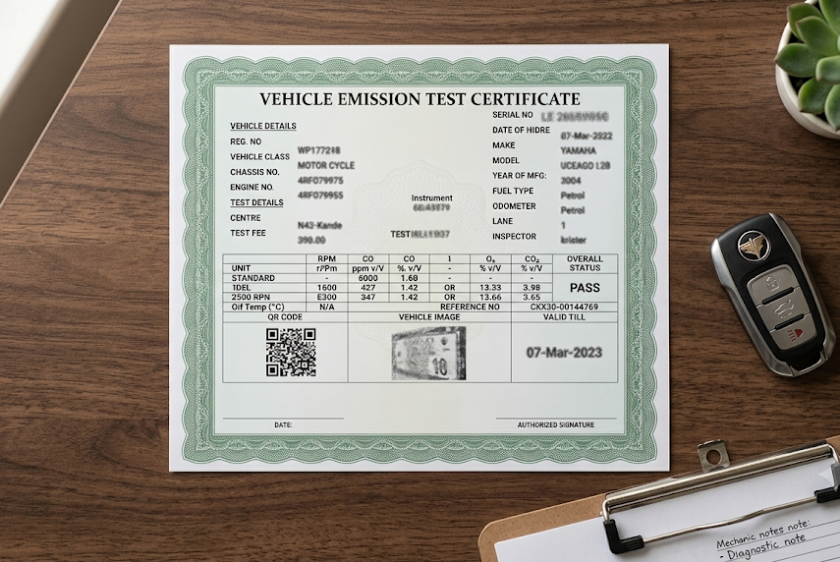
Every year, millions of vehicle owners in Sri Lanka collect their emission certificate, glance at the result, see the word PASS, and move on. The certificate goes into the glove compartment, the revenue license gets renewed, and the numbers on the report are forgotten. But those numbers tell a story about the health of your engine that most vehicle owners are missing.
Understanding what your emission certificate is actually measuring can help you catch engine problems early, save money on fuel, and make smarter maintenance decisions. Here is a plain-language guide to reading your emission report.
What Gets Tested: Petrol vs Diesel
The emission test measures different things depending on whether your vehicle runs on petrol or diesel. Knowing which test applies to your vehicle is the first step to understanding your results.
Petrol vehicles undergo a gas analyzer test. The probe inserted into your exhaust measures two key gases: carbon monoxide (CO) and hydrocarbons (HC). These are measured at two engine speeds — idle (when the engine is running but the vehicle is stationary) and at approximately 2,500 RPM (a moderate engine speed). The oil temperature must be around 55°C for the readings to be valid.
Diesel vehicles undergo a smoke opacity test using what is called the snap acceleration method. Instead of measuring specific gases, this test measures how opaque (dense) the smoke coming from your exhaust is. Three warm-up acceleration cycles are performed, followed by three measurement cycles. The result is expressed as a K-value, which represents the absorption coefficient of the smoke.
Breaking Down the Numbers: Petrol Vehicles
Carbon Monoxide (CO) — measured in % v/v (percentage by volume). CO is a colourless, odourless gas produced when fuel does not burn completely. A healthy, well-tuned petrol engine should produce very low CO levels. If your CO reading is high, it usually means your engine is running rich — there is too much fuel relative to air in the combustion chamber. Common culprits include a faulty oxygen sensor, leaking fuel injectors, a dirty air filter, or old engine oil.
Hydrocarbons (HC) — measured in ppm v/v (parts per million by volume). HC represents unburnt fuel particles escaping through the exhaust. High HC readings typically point to incomplete combustion, which can be caused by worn spark plugs, ignition timing issues, or a failing catalytic converter. Think of HC as wasted fuel — your engine is not burning everything it should be.
Your certificate will show readings at both idle and at 2,500 RPM. Comparing the two can be revealing. If your readings are significantly worse at idle than at higher RPM, it may indicate an issue that only manifests when the engine is under low load, such as a fouled spark plug that clears up at higher speeds.
Breaking Down the Numbers: Diesel Vehicles
Smoke Opacity (K-value) — measured as an absorption coefficient. The K-value tells you how much light is absorbed by the smoke coming from your exhaust pipe. A lower K-value means cleaner exhaust; a higher value means denser, dirtier smoke. If you have ever seen a diesel vehicle belching thick black smoke during acceleration, that vehicle would have a very high K-value.
High smoke opacity in diesel vehicles is commonly caused by worn or clogged fuel injectors, a dirty or malfunctioning turbocharger, excessive engine wear, or poor-quality diesel fuel. In older diesel vehicles without modern emission control systems, smoke opacity tends to increase gradually as the engine ages.
What Does PASS Actually Mean?
A PASS result means your vehicle’s emission readings fell within the permissible limits set by the government for your vehicle category and fuel type. It confirms that your vehicle is within acceptable environmental standards at the time of testing.
However, here is something most vehicle owners do not realise: a pass is not necessarily a clean bill of health. If your readings are close to the upper limit, your engine is already under strain and likely burning more fuel than it should be. A borderline pass today could easily become a fail in a few months if a minor issue worsens.
If your certificate shows readings that are well within limits, that is a good sign that your engine and emission control systems are functioning efficiently. If the numbers are creeping toward the threshold, treat it as an early warning and schedule a maintenance check before your next test.
What a FAIL Report Tells You
If your vehicle fails, the report will clearly show which parameter exceeded the limit and by how much. This is valuable diagnostic information. A mechanic who sees that your CO is high but HC is normal can narrow down the problem much faster than if you simply said the vehicle failed.
When you visit a repair shop after a failure, bring your emission report with you. It gives the mechanic a starting point and can prevent unnecessary guesswork and expense.
Why These Numbers Matter Beyond the Test
Your emission readings are essentially a window into how well your engine is performing. High CO suggests your fuel system is out of balance. High HC means fuel is being wasted. High smoke opacity in a diesel vehicle means the combustion process is deteriorating.
In every case, the engine problem that causes elevated emissions also costs you money through increased fuel consumption. Fixing the root cause does not just help you pass the test — it improves your vehicle’s efficiency and extends its lifespan.
The next time you collect your emission certificate from LAUGFS Eco Sri, take a moment to look at the numbers. They are telling you more about your vehicle than you might think.
More than a test. A responsibility.