

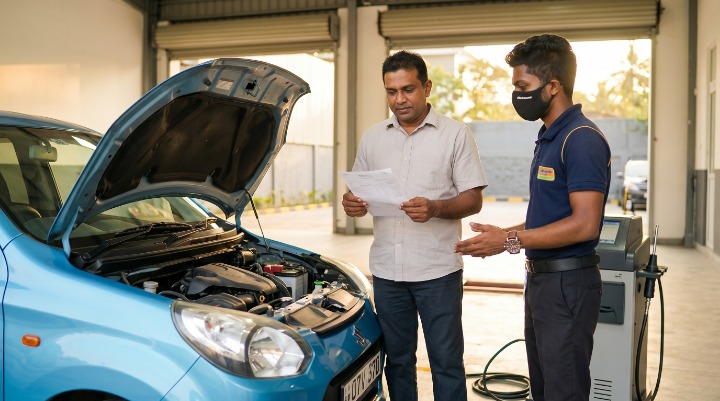
You drove to the testing center, waited in line, and handed over your documents. A few minutes later, the result came back: FAIL. If this has happened to you, you are not alone. Thousands of vehicles in Sri Lanka fail the emission test every year, and the reasons are often simpler and cheaper to fix than most owners expect.
Understanding why your vehicle failed and what to do next can save you time, money, and unnecessary stress. Here is everything you need to know.
Why the Emission Test Matters
The Vehicle Emission Test (VET) is not just another bureaucratic step on the way to renewing your revenue licence. It is a scientific check that measures the pollutants your vehicle releases into the air. For petrol vehicles, the test measures carbon monoxide (CO) and hydrocarbons (HC) at idle and at 2,500 RPM. For diesel vehicles, a smoke opacity test is performed during snap acceleration.
Vehicles that exceed the permissible limits are contributing disproportionately to air pollution, which affects the respiratory health of everyone around them, especially children and the elderly. The test exists to catch these vehicles early and get them repaired before the damage compounds.
What Happens Immediately After You Fail
If your vehicle fails the emission test at a LAUGFS Eco Sri centre, you will receive a fail report that clearly states which parameters exceeded the limit. A technician will also provide verbal guidance on the likely areas that need attention.
Here is the important part: you are entitled to two free re-tests within 60 days. That means you do not need to pay for the test again as long as you return within two months after getting the necessary repairs done. You can also choose to get re-tested at any authorised centre, not necessarily the same one where you originally tested.
The Most Common Reasons Vehicles Fail
Dirty or old engine oil. Engine oil degrades over time and accumulates combustion byproducts. Old oil releases more hydrocarbons into the exhaust, which pushes your HC readings above the limit. If you have been delaying your oil change, this could be the single biggest reason for failure.
A clogged or worn air filter. The air filter ensures the right amount of clean air enters the combustion chamber. When it is blocked with dust and debris, the air-fuel mixture becomes too rich, meaning there is more fuel than the engine can burn efficiently. The result is excess CO and HC in the exhaust.
Worn spark plugs (petrol vehicles). Spark plugs ignite the air-fuel mixture in each cylinder. When they are worn or fouled, they misfire, leaving unburnt fuel in the exhaust. Replacing spark plugs is one of the most cost-effective fixes for a failed emission test.
Faulty oxygen sensor. The oxygen sensor monitors how much unburnt oxygen is in the exhaust and adjusts the fuel mixture accordingly. A malfunctioning sensor can cause the engine to run too rich or too lean, both of which produce elevated emissions.
A damaged or inefficient catalytic converter. The catalytic converter is the last line of defence in your exhaust system. It chemically converts harmful gases like CO and HC into less harmful substances. When it deteriorates, usually after 100,000 kilometres or more, the conversion efficiency drops and emissions spike. This is one of the more expensive repairs, but it is often the root cause of persistent failures.
Fuel quality issues. Low-grade or contaminated fuel can cause incomplete combustion, leading to higher emissions. While you cannot control fuel quality at the pump, using fuel from reputable stations and occasionally running a fuel system cleaner can help.
Exhaust leaks. Cracks or holes in the exhaust system can cause inaccurate readings during the test and also allow harmful gases to escape before they reach the catalytic converter.
How to Fix It: A Step-by-Step Approach
If your vehicle has failed, resist the urge to rush back to the testing centre without doing anything. Instead, follow a systematic approach that addresses the most likely issues first.
Start with the basics. Get a fresh oil change using the grade recommended in your vehicle manual. Replace the air filter if it has not been changed in the last 12,000 kilometres. Check and replace spark plugs if they are beyond their service interval.
Next, visit a trusted mechanic. Ask them to check the oxygen sensor, catalytic converter, and exhaust system for leaks. If your vehicle has an on-board diagnostic (OBD) system, a scan can quickly identify fault codes related to emission components.
After repairs are done, drive the vehicle for at least 30 to 50 kilometres before returning for the re-test. This allows the engine computer to recalibrate and register the improvements. Heading straight from the repair shop to the testing centre without driving can sometimes lead to another failure even when the repairs were done correctly.
Prevention Is Cheaper Than Repair
The best way to avoid a failed emission test is to keep up with routine maintenance throughout the year, not just before the test is due. Regular oil changes, timely air filter replacements, and periodic spark plug checks will keep your engine running clean.
Pay attention to warning signs like black or blue exhaust smoke, a rough idle, reduced fuel economy, or a persistent check engine light. These are often early indicators that your emissions are creeping above acceptable levels.
A Fail Is Not the End — It Is a Fresh Start
A failed emission test is not a punishment. It is a diagnosis. It tells you exactly what your vehicle needs to run cleaner and more efficiently. In many cases, the repairs that bring your emissions back within limits also improve fuel economy, extend engine life, and make your vehicle more pleasant to drive.
Visit your nearest LAUGFS Eco Sri centre for your emission test, and if your vehicle does not pass, our team will guide you on the next steps. Remember, you have two free re-tests within 60 days.
More than a test. A responsibility.