

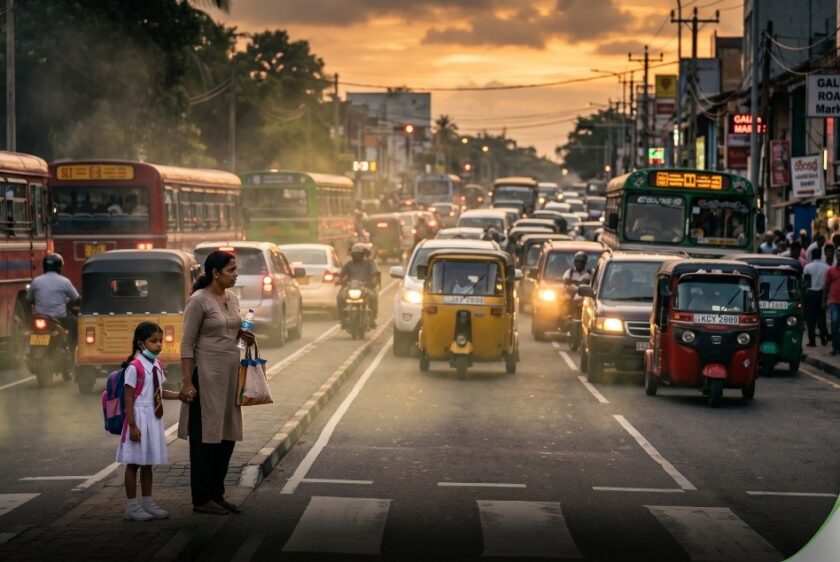
Colombo ranked as the fifth most traffic-congested city in the world in 2025, with the average commuter spending nearly 60 minutes on a one-way journey. If you live or work in the capital, that statistic probably does not surprise you. What might surprise you is what those hours stuck in traffic are doing to your health.
Traffic congestion is not just a time problem. It is a health problem. And understanding how it affects you is the first step toward protecting yourself and your family.
What Happens to Air Quality When Traffic Slows Down
When vehicles move freely on an open road, their exhaust disperses relatively quickly into the atmosphere. But in congested conditions, everything changes.
Vehicles stuck in stop-and-go traffic produce significantly more emissions than vehicles cruising at a steady speed. Every acceleration from a standstill, every idle at a red light, and every sudden brake generates a burst of exhaust gases. Research has shown that emissions during congested driving can be 40 to 60 percent higher than during free-flowing traffic conditions.
At the same time, slower vehicle speeds reduce the turbulence that normally helps disperse pollutants. The result is a concentration of exhaust gases at ground level, exactly where pedestrians walk, cyclists ride, and drivers sit with their windows open. In heavily congested corridors, nitrogen dioxide (NO₂), carbon monoxide (CO), and fine particulate matter (PM2.5) can reach levels several times higher than ambient air quality norms.
The Health Toll on Colombo’s Commuters
A 2025 study published in BMC Public Health investigated air pollution exposure inside vehicles on congested Colombo roads. The researchers measured particulate matter levels inside three common vehicle types: three-wheelers, non-air-conditioned buses, and air-conditioned cars. The findings confirmed what health experts had long suspected: commuters in open vehicles on congested roads face significantly elevated exposure to harmful pollutants.
The health effects of this daily exposure accumulate over time. Short-term effects include headaches, eye irritation, throat discomfort, and fatigue, symptoms that many Colombo commuters experience but attribute to stress rather than pollution. Longer-term exposure is linked to far more serious outcomes: chronic respiratory conditions, reduced lung function, cardiovascular disease, and increased risk of stroke.
For certain groups, the risks are higher. Three-wheeler drivers and bus conductors, who spend eight or more hours daily in open-air traffic environments, face the most concentrated exposure. Children commuting to school during morning rush hours are particularly vulnerable because their lungs are still developing and they breathe at a faster rate relative to their body size. The elderly and those with pre-existing respiratory conditions are also at elevated risk.
Why Your Own Vehicle’s Emissions Matter in This Picture
In congested traffic, you are not only breathing in everyone else’s exhaust. Your own vehicle is contributing to the problem. A poorly maintained vehicle stuck in traffic becomes a concentrated source of pollution for the vehicles and people immediately around it.
Consider this: vehicle emissions are responsible for over 60 percent of total air pollution in Colombo, and the majority of those emissions occur during peak traffic hours when congestion is at its worst. Every vehicle in that queue is either part of the problem or part of the solution, depending on how well its engine is functioning.
A vehicle that has passed its emission test is confirmed to be operating within safe limits. Its engine is burning fuel efficiently, its exhaust system is functioning properly, and it is releasing the minimum possible pollutants into the congested air around it. A vehicle that has not been tested, or worse, one that would fail if tested, is releasing disproportionately higher levels of harmful gases into the air that everyone in the traffic queue is breathing.
Practical Ways to Protect Your Health in Traffic
Use recirculated air conditioning.
If your vehicle has air conditioning, switch to the recirculate setting when stuck in heavy traffic. This prevents outside air from being drawn directly into the cabin, significantly reducing your exposure to exhaust particles and gases. Studies have shown that cabin air filtration can reduce fine particulate exposure by approximately 30 percent.
Keep windows closed in heavy congestion.
Open windows in slow-moving traffic create a direct pathway for ground-level exhaust gases to enter your vehicle. In congested areas, closed windows with recirculated AC provide far better air quality inside the cabin than open ventilation.
Choose your route and timing wisely.
If you have flexibility, adjusting your commute by even 30 minutes can dramatically change your pollution exposure. Colombo’s peak congestion typically runs from 7:30 to 9:15 AM and 5:00 to 6:30 PM. Travelling outside these windows means fewer vehicles on the road, faster-moving traffic, and lower pollutant concentrations.
Maintain your own vehicle.
This is the one factor entirely within your control. A vehicle that runs cleanly does not just protect you. It protects the three-wheeler driver beside you, the pedestrian at the crossing, and the child in the school van behind you. Regular servicing and an annual emission test at LAUGFS Eco Sri ensure your vehicle is not adding unnecessary pollution to already congested roads.
If you walk or cycle, choose parallel streets.
Major arterial roads during rush hour have the highest pollution concentrations. Parallel residential streets, even just one block away, often have significantly lower pollutant levels. If your daily walk or cycle commute takes you along a busy road, consider an alternative route.
A Collective Problem That Needs Individual Action
Traffic congestion in Colombo is a systemic issue that requires infrastructure investment, public transport improvements, and urban planning solutions. These changes take time. But the health effects are happening right now, on every congested road, during every rush hour, to every commuter.
What you can do today is ensure that your vehicle is not making the problem worse. A properly maintained vehicle with a valid emission certificate is your personal contribution to cleaner air in traffic. Multiply that across the hundreds of thousands of vehicles in Colombo, and the cumulative impact is substantial.
The air inside your daily traffic queue is shaped by every vehicle in it. Make sure yours is running clean.