

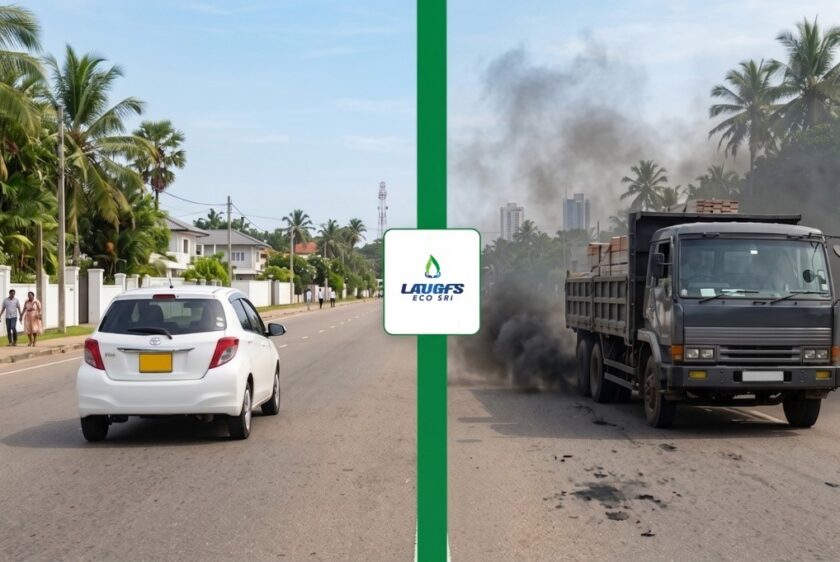
If you own a vehicle in Sri Lanka, chances are you have wondered whether diesel or petrol is the better choice. The debate usually centres on fuel cost and mileage. But there is another question that deserves attention: which fuel type does more harm to the air you and your family breathe? The answer is not as straightforward as you might expect.
Understanding the difference between diesel and petrol emissions helps you make smarter decisions about vehicle maintenance, fuel choices, and how you use your vehicle every day. It also explains why emission testing treats diesel and petrol vehicles differently.
The Core Difference: What Comes Out of Each Exhaust
Petrol and diesel engines burn fuel differently, and that difference determines what pollutants they release into the air.
Petrol engines produce higher levels of carbon monoxide (CO) and volatile organic compounds (VOCs). Carbon monoxide is a colourless, odourless gas that reduces the blood’s ability to carry oxygen. In enclosed or congested areas, high CO concentrations pose a serious health risk.
Diesel engines produce significantly higher levels of nitrogen oxides (NOx) and fine particulate matter (PM2.5). These tiny particles penetrate deep into the lungs and are linked to asthma, heart disease, and increased cancer risk. Research has found that diesel vehicles can produce more than four times the overall pollution of equivalent petrol vehicles when real-world driving conditions are considered.
On the other hand, diesel engines have traditionally produced less carbon dioxide (CO₂) per kilometer because they are more fuel-efficient. This is why diesel was once promoted as the “greener” option in Europe. However, more recent lifecycle analyses have shown that when you account for the energy-intensive refining of diesel fuel and the heavier engine components, diesel vehicles can emit more total CO₂ over their lifetime than petrol equivalents.
Why Diesel Faces Stricter Emission Testing
In Sri Lanka, the Vehicle Emission Testing programme measures different pollutants for diesel and petrol vehicles, reflecting their distinct emission profiles.
For petrol vehicles, the test primarily measures carbon monoxide and hydrocarbon levels. For diesel vehicles, the test focuses on smoke opacity, which indicates how much particulate matter the engine is releasing. A diesel vehicle that produces dense black or grey smoke is almost certainly exceeding safe emission levels.
Diesel vehicles tend to have higher failure rates in emission testing, particularly older models that lack modern pollution control technology like diesel particulate filters (DPFs). If you drive a diesel vehicle, regular maintenance is not just recommended, it is essential for passing your emission test.
Sri Lanka’s Fuel Quality Journey
The quality of fuel available in a country directly affects how clean vehicle emissions can be. Sri Lanka has made significant progress in this area over the past two decades.
In June 2002, the Ceylon Petroleum Corporation completely phased out leaded petrol, a major step in reducing toxic lead pollution. In January 2004, the sulphur content of auto diesel was reduced to 3,000 parts per million (ppm). By 2014, super diesel with just 500 ppm sulphur was introduced, and in 2018, Sri Lanka introduced Euro IV standard fuel with sulphur content as low as 10 ppm.
These improvements have enabled modern engines with better emission control technologies to function more effectively. Cleaner fuel means cleaner combustion, which means fewer harmful pollutants in the exhaust. However, many vehicles on Sri Lankan roads are older models that cannot fully benefit from these fuel quality improvements because they lack the engine technology to take advantage of them.
Practical Tips for Both Diesel and Petrol Vehicle Owners
If you drive a petrol vehicle:
Ensure your catalytic converter is functioning properly. This single component is responsible for converting the majority of carbon monoxide and hydrocarbons into less harmful gases. A failing catalytic converter can multiply your vehicle’s harmful emissions several times over. Keep your spark plugs clean and replace them according to the manufacturer’s schedule. Worn spark plugs cause incomplete combustion, which increases both emissions and fuel consumption.
If you drive a diesel vehicle:
Pay close attention to your fuel injectors and air filter. Clogged injectors cause poor fuel atomisation, leading to incomplete combustion and the dense black smoke that indicates high particulate emissions. If your diesel vehicle is equipped with a DPF, ensure it is not blocked. DPF regeneration requires occasional sustained driving at higher speeds, so vehicles used exclusively for short urban trips may develop DPF issues. Watch your engine oil. Diesel engines are harder on oil than petrol engines, and degraded oil increases soot production significantly.
For all vehicle owners:
Get your annual emission test done on time. The test is specifically designed to catch the issues that each fuel type is most prone to. A vehicle that passes its emission test at a LAUGFS Eco Sri centre is confirmed to be operating within Sri Lanka’s national standards, meaning it is burning fuel efficiently and releasing the minimum possible pollutants.
The Bigger Picture: Every Vehicle Counts
The diesel versus petrol debate does not have a single winner. Both fuel types have environmental trade-offs, and neither is “clean” in absolute terms. What matters most is how well each vehicle is maintained and how responsibly it is driven.
In Sri Lanka, where vehicular emissions contribute to over 60 percent of air pollution in Colombo alone, every vehicle that runs cleaner makes a measurable difference. Whether you drive a diesel lorry or a petrol hatchback, the same principle applies: a well-maintained vehicle pollutes less, costs less to run, and keeps your family and community healthier.
Your next emission test is a good place to start. It takes minutes, costs only the standard government-approved fee, and gives you a clear picture of where your vehicle stands.